

Something changes when a technician starts picking up a few jobs after work.
At first, it seems harmless enough. A neighbor needs help with an air conditioner that stopped cooling. A former customer calls about a broken appliance. Someone in a local Facebook group is looking for an electrician, computer technician, or mobile mechanic—and they would rather hire a recommended person than spend half the afternoon waiting on hold with a national service company.
Then the phone rings again.
Soon, evenings that used to be free are filled with estimates, parts orders, customer updates, and invoices that still need to be paid. The occasional side job develops a schedule. Then it develops regular customers. Before long, it begins behaving suspiciously like a real business.
That is when the question becomes difficult to ignore:
Could this technician side hustle become a full-time company?
Across HVAC, electrical work, plumbing, appliance repair, automotive service, electronics, and IT support, independent technicians are discovering that technical skill is only the starting point.
The real transition happens when they learn how to price their work, attract the right customers, control their schedules, and build systems that do not depend entirely on memory and caffeine.
Being excellent with the tools may win the first job. Building a business around that skill is what creates a career.
Why Independent Technicians Are Finding New Opportunities
Technical services have an advantage over many popular side hustles: they solve problems people cannot easily ignore.
A furnace does not begin working because the homeowner decides to wait another week. A restaurant cannot simply overlook a failed refrigeration unit. When a small office loses its internet connection, someone has to identify the problem before work can continue.
These are immediate, practical problems—and customers are usually willing to pay someone capable of solving them correctly.
Demand also remains healthy across several skilled trades. According to the U.S. Bureau of Labor Statistics, employment for HVAC technicians is projected to grow by 8 percent from 2024 to 2034. Electrician employment is expected to grow by 9 percent over the same period. Plumbing is growing more slowly, but the field is still expected to produce tens of thousands of openings every year.
The broader small-business environment is substantial too. The U.S. Small Business Administration reported that more than 36 million small businesses were operating in the country in 2026.
Independent technicians are not working on the edges of the economy. They are part of its everyday machinery.
Still, a busy market can hide a poorly managed business. A full calendar does not automatically produce a healthy bank account.
The Side Hustle Is More Than Extra Income
The most thoughtful technicians use their side hustle as a testing ground.
While still receiving a regular paycheck, they can observe which services customers request most often. They can compare the profit from different jobs after accounting for parts, fuel, and travel time. They can notice which customers generate referrals and which types of work create more frustration than income.
That information is worth considerably more than a new logo or a box of glossy business cards.
The side-hustle stage also helps a technician discover whether the local market wants a general service or a specialist.
An appliance technician may notice that premium refrigerators produce the best combination of demand and profit. An IT technician may discover that dental practices and small law firms repeatedly need the same kinds of support. A mechanic might find a steady market serving delivery drivers or small commercial fleets.
A broad service business can certainly succeed, but a clear specialty often makes the early stages easier.
It helps customers remember what the company does. It simplifies advertising. It can also make diagnosis, parts planning, training, and pricing more efficient.
Compare these two messages:
“We repair all types of commercial equipment.”
“We provide rapid refrigeration repairs for independent restaurants.”
The first is broad. The second immediately tells a particular customer, “This company understands my problem.”
Choosing a niche does not mean refusing every job outside it. It simply gives the business a more memorable position in the market.
Small detail. Big impact.
The First Major Shift: Pricing Like a Business
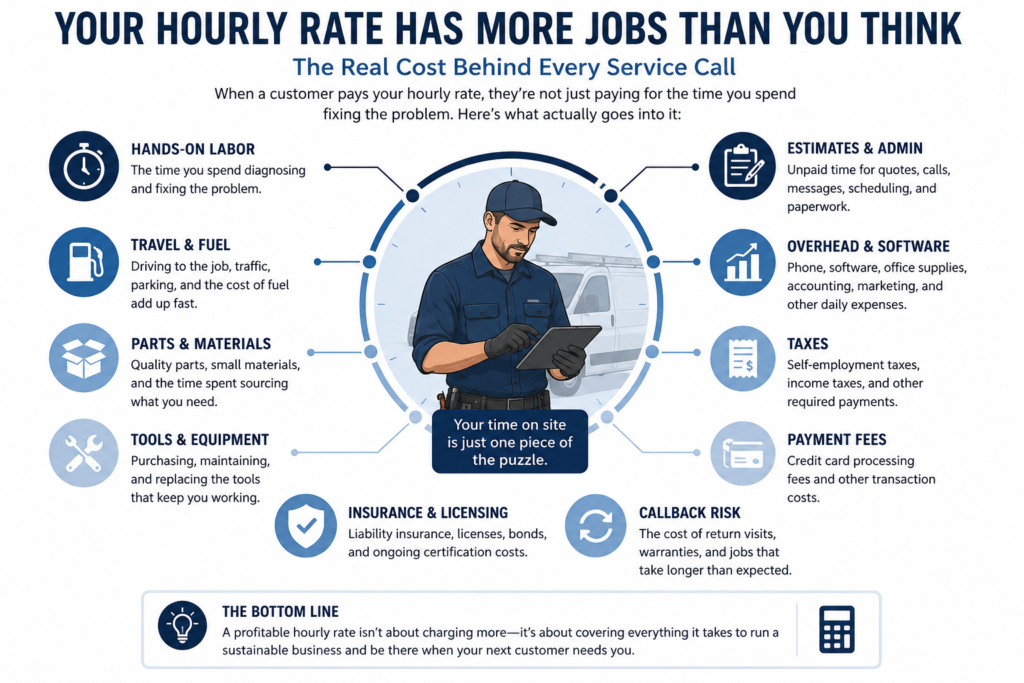
Many technicians begin by pricing side jobs according to a familiar calculation.
They estimate the number of hours, choose a reasonable hourly rate, add the cost of parts, and send the customer a total.
It sounds sensible. It is also where many promising businesses begin losing money without realizing it.
An employee’s hourly wage is not the same as the hourly revenue a company needs.
A self-employed technician must cover fuel, insurance, licensing, tools, software, advertising, payment-processing charges, bookkeeping, taxes, vehicle maintenance, training, unpaid estimates, and occasional callbacks.
Then there are the hours that never appear on an invoice.
A repair may take two hours at the customer’s property, but another hour may disappear into sourcing a part, preparing the estimate, traveling to the location, updating the customer, and completing the invoice.
Charge only for the two hands-on hours, and the schedule may appear profitable while the bank account tells a different story.
A sustainable independent technician business needs to calculate its minimum profitable rate. Depending on the trade, that may involve a diagnostic fee, a service-call charge, flat-rate pricing for common tasks, or minimum job values.
Some technicians prefer hourly pricing. Others charge by the job or project. There is no perfect model for every trade.
What matters is knowing exactly what the price must cover.
Clear pricing also improves the customer experience. A professional estimate should explain the work, the price, what is included, payment expectations, and any warranty conditions.
Customers do not always select the lowest bidder. Quite often, they choose the technician who makes the problem and the proposed solution easiest to understand.
Pricing discipline also includes knowing when to turn work down.
A distant job may consume too much travel time. Unfamiliar equipment may create unpredictable delays. Some customers expect guarantees no responsible technician can provide. Other projects have vague scopes that seem to expand every time the phone rings.
Declining a job can feel uncomfortable when the company is new. Sometimes, however, “no” is the most profitable answer available.
The Business Is Built Between the Repair Jobs
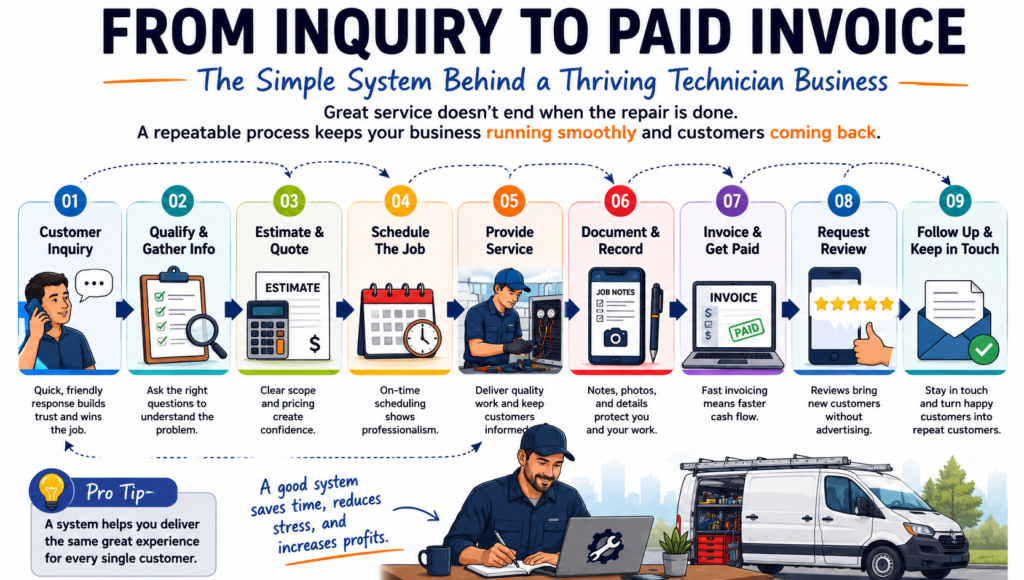
Here is the catch: completing the repair may be the easiest part of the day.
The business is built in the spaces around it.
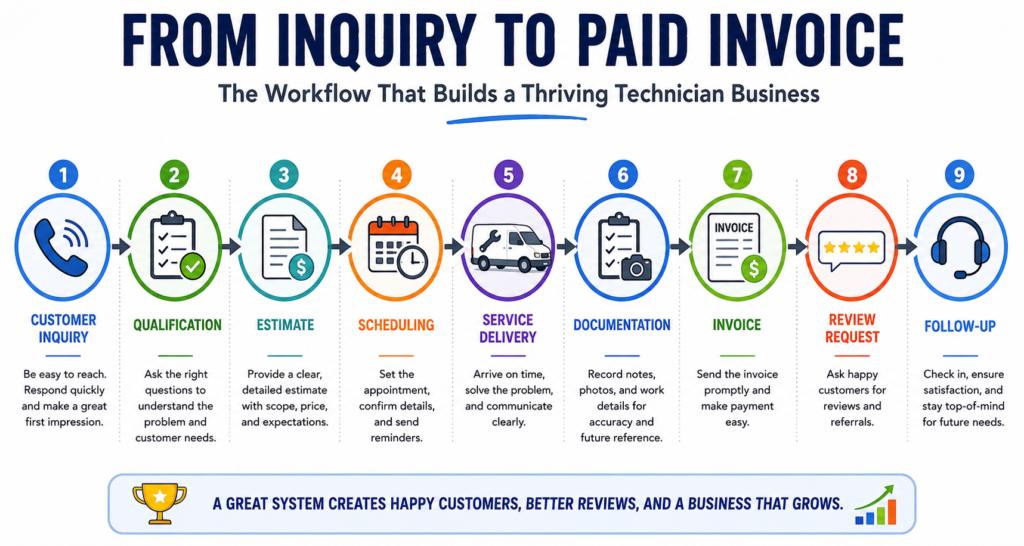
Successful service companies develop repeatable ways to answer inquiries, qualify customers, schedule visits, prepare estimates, order parts, document work, collect payment, request reviews, and follow up afterward.
These activities may look like administrative work because that is exactly what they are.
They are also where money quietly slips away.
A missed call can become a lost customer. A vague estimate can become a disagreement. Poor route planning can turn a productive afternoon into an extended tour of local traffic.
Even a solo technician can benefit from a basic field-service or customer-management system. Keeping customer history, appointments, estimates, invoices, job photos, and reminders in one place reduces the number of things that must be remembered manually.
It is not glamorous. That may be why it works.
A small operation can begin with a few straightforward standards:
- Every customer inquiry receives a response within a defined period.
- Every job receives a written scope and estimate.
- Every completed visit includes notes and photographs.
- Every invoice is sent promptly.
- Every satisfied customer receives a review request.
- Every callback is documented and investigated.
None of this makes for an exciting business montage. It does make the company easier to operate, evaluate, and eventually expand.
What Technician-to-Owner Stories Can Teach Us
Public interviews with service-business owners show that there is no single path from technician to entrepreneur.
The recurring lessons, however, are surprisingly consistent.
One Housecall Pro case study followed Jason of Allen Air, who moved from technician to HVAC business owner in 2018. According to the interview, his small team generated approximately $800,000 during its first full year.
The revenue figure naturally attracts attention. The more useful lesson is how the company responded when conditions became difficult: it reduced unnecessary expenses, stayed proactive, and focused more closely on relationships with existing customers.
Another Housecall Pro interview featured Brandon Vaughn, who described home-service growth as a series of stages.
The first stage is the owner-operator phase. The founder performs most of the billable work while also handling calls, estimates, customer communication, marketing, and administration.
The warning signs are easy to recognize. Work is booked weeks ahead. Messages remain unanswered. Quotes take too long to send. Marketing becomes something the owner promises to handle “when things calm down.”
Things rarely calm down by themselves.
Vaughn’s point was not that every busy technician should immediately hire an employee. It was that growth eventually reveals the company’s biggest constraint.
Perhaps there is not enough field capacity. Perhaps administrative work is consuming the owner’s time. Maybe leads are coming in but are not being followed up properly. In other cases, the business simply lacks a reliable process.
The bottleneck shows the owner what needs attention next.
Matt Mauzy offers another example. He took control of an HVAC business while still in his twenties and later grew it beyond $20 million in annual sales, according to a separate Housecall Pro interview.
His focus was not on being the smartest technician in every room. It was on choosing capable people, giving them real responsibility, and creating an environment in which they could take good care of customers.
That requires a major change in identity.
A technician creates value by personally solving a problem. A business owner creates a company that can solve the problem reliably—even when the owner is not the person holding the tools.
Knowing When to Go Full-Time
One unusually profitable month can be exciting.
It is not a business plan.
A technician should consider going full-time when demand has become consistent rather than occasional. That means looking for patterns across several months, including quieter periods—not making the decision after one frantic summer or a sudden burst of referrals.
Several signs can make the transition less risky.
Consistent Monthly Revenue
Revenue should show a repeatable pattern. Seasonal fluctuations are normal, but the technician needs evidence that customers continue to appear across different periods.
Known Profit Margins
Revenue is the amount collected. Profit is what remains after parts, fuel, fees, insurance, tools, travel, and overhead.
A technician who does not know the difference may leave a stable job to discover that the side hustle was paying far less than expected.
A Cash Reserve
The business needs enough cash to survive slow weeks, late customer payments, vehicle trouble, damaged tools, and unexpected equipment costs.
A personal emergency fund and a business operating reserve should ideally be treated separately.
Reliable Lead Sources
Referrals are powerful, but the owner should understand how customers continue to find the business.
That may involve Google searches, repeat clients, commercial accounts, partnerships, social media, neighborhood recommendations, or local advertising.
Relying on a single lead source makes the business vulnerable.
Proper Licensing and Insurance
Requirements vary by trade and location. Before working full-time, technicians should confirm the licenses, permits, registrations, and insurance coverage required where they operate.
A Tax Plan
Self-employed workers in the United States generally file an annual tax return and may need to make estimated tax payments during the year.
Tax obligations should be planned for as money is earned, not discovered when a large payment becomes due.
Working Business Systems
Scheduling, estimating, invoicing, customer records, payment collection, and communication should already function reasonably well before the business becomes the owner’s only source of income.
A useful exercise is to calculate the revenue needed to replace the full value of employment—not merely the salary.
A regular job may include paid leave, employer tax contributions, tools, training, insurance, or vehicle-related expenses. Once self-employed, the business owner must cover many of those costs.
Freedom has an invoice. It is better to read it before handing in a resignation.
Local Reputation Can Become a Growth Engine
Large service companies can spend heavily on advertising. Independent technicians often cannot, especially during the early stages.
What they can build is local trust.
A complete Google Business Profile is one of the most useful starting points. Accurate contact details, clear service descriptions, photos of completed work, and genuine customer reviews help potential customers understand what the business offers.
The key is to create a process rather than depend on luck.
Customers often intend to leave a review and then forget. A short, polite message sent immediately after a successful job is far more effective than hoping they remember several weeks later.
Independent technicians can also create helpful local content.
An appliance technician might explain when a refrigerator is worth repairing. An HVAC contractor could share seasonal maintenance advice. An IT technician might demonstrate a common backup mistake made by small businesses.
The content does not need expensive production.
A straightforward phone video that solves a real problem can build more trust than a polished advertisement featuring suspiciously cheerful people holding spotless tools.
Partnerships can be equally valuable. Property managers, real estate agents, remodelers, restaurants, retailers, and other trades frequently need dependable technical support.
One strong commercial relationship may produce more predictable work than repeatedly chasing individual customers.
The goal is not to appear everywhere.
It is to be easy to find, easy to understand, and easy to trust.
Turning One-Time Repairs Into Predictable Revenue
Emergency jobs can introduce customers to the business. Repeat services create stability.
Depending on the trade, technicians may offer preventive maintenance plans, scheduled inspections, filter or component replacement, software-support agreements, priority booking, or periodic equipment checks.
Recurring services make life easier for both sides.
Customers receive reminders and reduce the risk of unexpected failures. The technician gains a more predictable schedule and a group of customers who already know the business.
That stability is particularly valuable during slower seasons. Instead of beginning each month with an empty calendar, the owner starts with scheduled work already in place.
Maintenance plans still need to provide genuine value.
A catchy membership name cannot rescue a weak offer. Customers should understand what is included, how often service occurs, whether they receive priority treatment, and how larger repairs are handled.
Useful? Absolutely. Miraculous? Hardly.
Hiring at the Right Time
The first employee can feel like a major milestone.
Sometimes it is. Other times, it simply exposes every process the owner never wrote down.
Hiring makes sense when demand consistently exceeds capacity, the company has enough profit to support payroll and related costs, and the owner can clearly explain how technical work and customer service should be handled.
Before adding another technician, the company should have basic procedures for common jobs, safety, pricing, documentation, customer updates, and quality control.
Without those systems, the employee can only learn by following the owner around.
The company grows, but the owner remains the bottleneck.
The first hire may not need to be another technician. If the owner is losing several billable hours each week to phone calls, booking, invoicing, and parts coordination, part-time administrative support may create more capacity than another field worker.
The right question is not, “What kind of employee makes the company look bigger?”
It is, “Which task is currently preventing the business from growing?”
Hire for the constraint, not for appearances.
A Thriving Business Does Not Have to Be a Large Business

The popular image of success in the trades usually includes branded trucks, a busy office, dispatch screens, and a team photograph wide enough to require panoramic mode.
That can be an excellent business.
It is not the only version of success.
Some independent technicians want to build regional companies with multiple crews. Others prefer a small, high-margin operation with a narrow specialty, repeat customers, and limited overhead.
Growth can mean higher revenue, but it can also mean better margins, more reliable commercial accounts, predictable maintenance work, or enough schedule control to take a genuine vacation.
Truck count is not the only useful measurement.
The owner should decide what the business is supposed to provide. Is the goal rapid expansion? Financial security? Greater control over working hours? Employment for family members? A company that can eventually be sold?
That decision affects pricing, hiring, service area, equipment purchases, and nearly every other choice that follows.
Frequently Asked Questions
How much should a technician save before going full-time?
There is no universal amount. The reserve should ideally cover several months of personal expenses as well as separate business operating costs. The right amount depends on seasonal demand, equipment needs, existing debt, household responsibilities, and the reliability of the customer pipeline.
Should an independent technician form an LLC?
An LLC may provide legal and administrative advantages, but the correct structure depends on location, taxes, risk exposure, and future hiring plans. A qualified accountant or business attorney can explain the local implications. Forming an LLC does not replace proper licensing or insurance.
How can a technician find the first customers?
Many technicians begin with referrals from former customers, friends, colleagues, and people familiar with their work. Local search visibility, customer reviews, community groups, and relationships with property managers or related trades can then create more consistent demand.
When should an independent technician raise prices?
Pricing should be reviewed whenever the cost of parts, fuel, insurance, wages, software, or tools changes. Prices may also need adjustment when the company is consistently booked beyond its capacity. A price increase should be based on operating costs, market position, and the value provided—not guilt about earning a reasonable profit.
From Skilled Technician to Confident Business Owner
A technician side hustle rarely becomes a full-time company in one dramatic moment.
The transformation happens through a series of practical decisions: identifying the most profitable services, choosing a clear market position, charging enough, formalizing the operation, creating reliable lead sources, documenting the work, and protecting cash flow.
Technical skill may win the first customer.
Reliability earns the second.
Systems make it possible to serve the hundredth without turning every week into an emergency.
That is the opportunity independent technicians are discovering. They are not simply exchanging hours for money. They are building trusted local businesses around expertise that customers genuinely need and often struggle to find.
The tools may still be sitting in the van. But once the business itself begins running smoothly, full-time ownership stops looking like a risky leap.
It starts looking like the next logical step.
Read More here